” My goal as a writer is to produce good multicultural children’s literature; stories where minority children are portrayed in a positive way, where they can see themselves as heroes, and where they can dream and have hopes for the future.”- René Colato Laínez
Awards: 2011 International Latino Book Award, Best Bilingual Children’s Book
* 2011 Americas Book Award Commended Title
* 2011 California Book Award Finalist
* 2011-2012 Tejas Star Book Award Finalist
* 2011 Junior Library Guild Selection

Born in El Salvador, René Colato Laínez learned the word escritor (writer) while he was at his uncle’s house. It was that word that set his path into motion. As a child he loved to write- he wrote about his toys and his school- and as he grew older he would write stories for his friends. Not only is he a bilingual author, he is also an elementary teacher at Fernangeles Elementary School, one of the most innovative schools in the San Fernando Valley . His goal as an author is to write positive stories about Latin American children living in the United States.
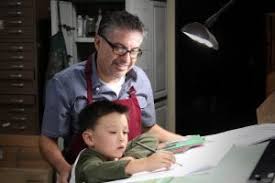
After just one meeting with a publisher, Joe Cepeda had secured a book contract while living in New York City and he’s been illustrating books ever since. He has illustrated over 30 children’s books and does numerous drawings for other publications and magazines. In 2000, he received the Recognition of Merit Award from the George G. Stone Center for Children’s Books. He lives in Southern California with his wife and son.
From North to South tells the very relevant and tender story of a family split apart because of deportation. Jose is a young boy whose mother is sent back to Tijuana, Mexico. He and his father frequently go to visit, but Jose is still left to wonder when they will be reunited as a family again.

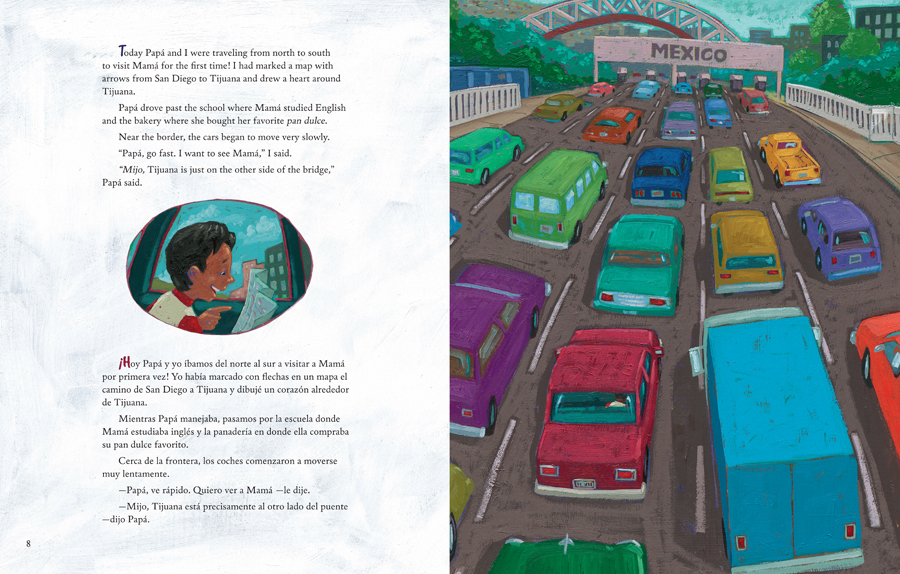
I love the use of color in this book- they are bright and vivid throughout and give off a very positive tone despite the heaviness of the topic. The bright colors are also very traditional of Mexican culture and allow the reader to feel like they are in Mexico. I also love the style that Joe Cepeda used with the colors. It looks like a mixture of paint and chalk the way that some of the walls are smeared and spread. The use of curved lines is another feature that supports the text in this book. Illustrators use line to direct the viewer’s eye (Tunnel et al, 2016, p. 41) and the eye is drawn towards both Jose and his mother throughout the story. The illustrations are used to develop and define the main characters, as well as determine the setting. All of these things will help advance the reader’s visual literacy as they explore each page. You can have students focus in on the facial expressions and how that has an effect on the mood of the story. You can also look at each page and ask students how the illustrations support the text and move the plot forward. Lastly, as the story is being read, you can ask guiding questions about the use of color or the different shapes? How do those things help support your experience reading the book?
The bilingual book does a great job of incorporating Spanish words into the English parts highlighting language which is an important piece of someone’s identity. The story also touches on family/parental norms when Jose talks about how his mother cooks and makes the best tortillas. I think there are many kids would be able to relate to this in their own families. When Jose visits his mother, they plant seeds together in an effort to feel connected until they can physically be together again. This shows the family’s love for one another and how close Jose is to his parents. This is another thing that students can relate to as they read this story.
Despite the fact that this book was published in 2013, it covers a very current and relevant topic-family separation- and it is told through the eyes of a young boy. Family is central to this book-focusing primarily on the relationship between Jose and his mother. These types of situations happen all of the time and continue to happen today, allowing the reader to attempt to understand what this feels like for all of those involved. However, as an adult reading this, I wonder the backstory to how the family got to the United States. Was the mother applying for citizenship? Did she extend her stay? Did she know that she could be sent back to Mexico at any time? Are these details important for the reader to know? I’m not really sure, but I know this topic can spark a bigger conversation. This is a very political issue and one that I am very sensitive to considering that many of our families at my school have had similar experiences. I think this story is very stereotypical of Central American families and it carries an underlying negative connotation. I know this book is considered multicultural, but I’m not sure how strong of a text it is for this genre. I would argue that this book “perpetuates a simplified, biased and often negative view of groups of people” (Tunnel et al, 2016, p. 203). Whenever there is a conversation or debate about immigration on the news, I always hear “If they’re here illegally, then they need to go back” or “Why would they put their child through that?”. I think if anything this book lends itself to why parents do what they do and why people want to make a life in the United States. While cultural authenticity is a sensitive issue with no real clear definition, I think this book is culturally authentic and accurate. Not only does the author have his own perspective, but it also tells the story of very real experiences. I wonder if that was the author’s intention. Overall, it’s not my favorite multicultural book.
This contemporary fiction picture book tells a story that covers a very real and current issue in today’s world. Regardless of age, any reader would be able to not only sympathize with Jose, but also empathize with him and what is happening with his family. It allows the reader an inside look into what is happening in someone else’s world. No matter where I live or what my life is like, my peers…are experiencing things unknown to me (Tunnel et al, 2016, p. 139). I would place this book in the problem novel category. These books “focus on coping with serious problems of the human condition” (Tunnel et al, 2016, p. 142). This particular book focuses on the problem of families being separated because of immigration. I think some would then say that this could be considered a controversial book due to the nature of the issue. I can imagine some adults reading this and not feeling as sympathetic towards Jose and his family.
 Good Books
Hi Emily, I read all three of your posts, but will comment here. I really appreciate your thoughtful and thorough reflections on each of the books as you considered each one from a perspective of cultural authenticity, language elements (poetic elements – for Crossover), and multicultural aspects. You bring up a very interesting criticism/concern regarding “From North to South” and I can understand your points. Thanks for sharing these. Sherry Taylor
LikeLike