“Whenever I see her, we laugh enough to last for the month. She’s my best friend, and someday when we’re old enough I’m going to talk her into staying here forever.”- Grace Lin (Where the Mountain Meets the Moon)
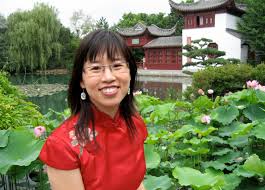
Growing up, Grace Lin was the only Asian in her school, as well as one of the few minorities in her town. This made life difficult for her and by the age of 11 she had “fully disregarded” her Asian heritage (Lin, 2009). As an adult, Lin regretted that decision as she traveled around Hong Kong, China and Taiwan. Her imagination was reawakened as she visited mountain towns, villages and gardens. Much of what she saw on that trip and remembered from her childhood, was what inspired her to write the Newberry Medal winner, Where the Mountain Meets the Moon. Grace Lin is an award willing author and illustrator who lives in Somerville, Massachusetts.
Published in 2009, Where the Mountain Meets the Moon, a modern fantasy, tells the story of young Minli who is on a fantastical journey to bring good fortune back to her family. As she ventures off to find the Old Man of the Moon to ask how she can bring good fortune to her family, she meets mythical creatures that teach her important life lessons. Does Minli find what she’s looking for?
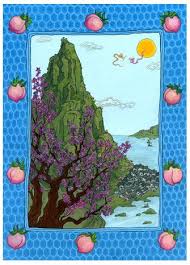
Minli is a strong, believable main character who is determined to find the answers she is looking for to bring happiness to her parents. As children, we don’t always recognize the humanness in our parents, but Minli does. I think some students will have a hard time understanding why she felt the need to leave home on this particular quest, but what’s important are the lessons learned, not only by Minli, but also her parents.
This book contains all six basic fantasy motifs, making it a modern high fantasy.
- Magic: Magic is woven throughout this book in all aspects from the setting to the plot to the characters. This quality is evident in the other five basic fantasy motifs, especially in the supporting characters.
- Other Worlds (Secondary Worlds): The other worlds in this book are merged with the realistic setting containing a hint of magic. As Minli makes her way to find the Old Man on the Moon, she stops in The City of Bright Moonlight, a secondary world. While there, she discovers that the city is divided into two- the outer city and the inner city. Inside the inner city is located the palace and the king.
- Good versus Evil: This basic theme gives rise to the conflict in a story (Tunnel et al, 2016, p. 127). Mid-way through Minli’s journey, she is confronted by the Green Tiger. The Green Tiger is the greedy king who destroyed everything and now he is back for revenge. “That tiger was truly evil. When you screamed, I could feel it” (Lin, 2009). Earlier in the book, Magistrate Tiger is introduced as an evil and greedy king. After discovering his son’s fate, he decides to take matters into his own hands. He “secretly ordered one of his servants to return to the grocer’s home and stab the girl with a knife,” (Lin, p. 23).
- Heroism: While not a hero in the traditional sense, Minli follows the hero’s journey while on her quest. She is called to adventure after disappointing her mother by purchasing a good luck goldfish. She leaves her safe and secure home to venture off into other worlds where she faces danger and meets mythical creatures. She passes through various trials as she searches for the Old Man on the Moon, for example when she must find and secure the borrowed line. She is assisted by Dragon on her journey who is a young dragon- only 100 years! “Protective figures provide a sense of security in a tension-filled world,” (Tunnel et al, 2016, p. 128). “GO AWAY!” Dragon thundered, in a voice that even made Minli quake (Lin, p. 163). It is early in on her journey when Minli matures and learns big life lessons. On page 159 in the book, Lin writes, “With pangs of guilt, she thought about how Ma and Ba pushed her to go home early from the field, how her rice bowl was always the first filled, how every night when she went to sleep in her warm bed she knew they were there.” Lastly, when Minli returns home, she brings with her the knowledge and experience she gained while on her quest.
- Special Character Types: Characters in modern fantasy books are “rarely typical humans” (Tunnel et al, 2016, p. 128). In addition to the other humans Minli meets, she meets dragons, tigers, and goldfish, all who can communicate with Minli. “You’re a talking fish?” Minli asked, her words tumbling into each other with excitement. “How can you talk?” (Lin, p. 28).
- Fantastic Objects: Characters in fantasy stories often employ magical props in accomplishing their heroic deeds (Tunnel et al, 2016, p. 129). Before leaving for her quest, Minli packs her bag with provisions. Using her rice bowl, water and a piece of bamboo she is able to determine which way to set off. “And she placed the needle onto the bamboo. Like magic, the needle spun around,” (Lin, p. 34).
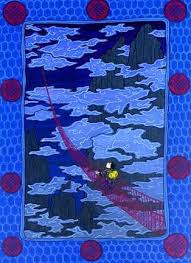
This book would most certainly be a strong text to use to strengthen students’ critical literacy. It is a very entertaining novel, but when you peel back the fantasy layers, you are left with a beautiful message. Minli is searching for the answer to her question of why her family is poor and unhappy. She thinks that if she can only bring back fortune, then they will be happy. When she meets the orphan Buffalo Boy who had nothing, “turned away her copper coin and laughed in the sun” (Lin, p. 159). In the same way, without Minli, Ma discovers that she is the key to her happiness and how her attitude had a direct impact on her impressionable daughter. You could pose the guiding questions of, what does it mean to have good fortune? Or what is the key to true happiness? And what life lessons does Minli learn on her quest?
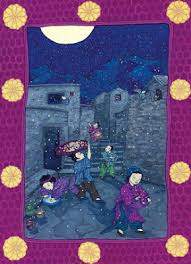
This novel is a parallel text where chapters go back and forth between characters. As Minli is on her journey, the reader also discovers how Ma and Ba are faring without their daughter. This would lend itself to evaluating perspective and discussing with students what they would do in those circumstances.
Lastly, this book would make a strong anchor text for a unit on a cultural study of Asia. From the stories to the pictures, students have much to explore and look at. I think it would be interesting to use this book to learn about what happened post-World War II to Japanese Americans. This book celebrates the Asian culture and I think that’s important as you explore racially charged events in history.
 Good Books
Hi, Emily. I enjoyed reading your post. I like how you wrote specifically about each of the six fantasy motifs and how they were used in this book. This was an interesting book with so many layers!
LikeLike