“But when you read books you almost feel like you’re out there in the world. Like you’re going on this adventure right with the main character. At least, that’s the way I do it. It’s actually not that bad. Even if it is mad nerdy.”- Matt de la Peña
Awards:
Winner of the 2016 Newbery Medal
A 2016 Caldecott Honor Book
A 2016 Coretta Scott King Illustrator Honor Book
A New York Times Book Review Notable Children’s Book of 2015
A Wall Street Journal Best Children’s Book of 2015

New York Times bestselling author, Matt de la Peña writes books for young adults and children, focusing on those with less. He draws on his own experiences with poverty as inspiration for his books. The most interesting plot lines to him are the kids who are fighting to “catch up” to everyone else in the race of life. I have his book Mexican Whiteboy, but have yet to read it. However, I’m excited to look into his other books for young adults and see if I can include them in my class library!

Illustrator, Christian Robinson, is a Caldecott Honoree and has received many awards for his books, including the Coretta Scott King Award Illustration Honor. He finds inspiration for his illustrations in everything from graphic art of the 50’s and 60’s to nature. In addition to working full time as an illustrator, he has also worked with Sesame Street and Pixar as an animator.
Last Stop on Market Street, published in 2015, is a contemporary realistic fiction picture book tells the story of CJ and his Nana as they venture on the bus from church to the soup kitchen. He is a very observant young boy, focusing on what he doesn’t have and complaining about having to go to the soup kitchen every Sunday. But there to keep him in check is his Nana who challenges him to see beauty in the ordinary and to be thankful for he has. As they get closer to the soup kitchen, CJ soon realizes how much his community has to offer and is appreciative of going every Sunday.
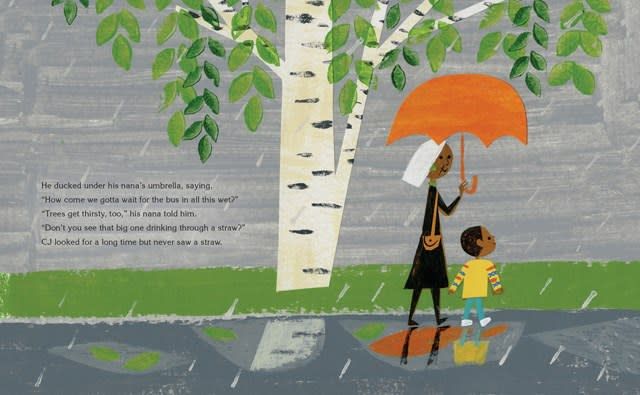
This book aligns with the features of contemporary realistic fiction very well. This story could very well have happened and probably happens all the time, especially for those who live in urban areas. CJ is a young, curious boy who is spending the day with his grandmother, complaining and asking questions the entire time- what kid can’t relate to this scenario?! Regardless of students’ backgrounds, they can connect to CJ on multiple levels- using public transportation, not having a car, absent parents, living with a grandparent, and being forced to do something you don’t want to do. He is relatable and allows readers to connect, “This story takes place in my world. This is how I live. This book is about a boy like me,” (Tunnel et al, 2016, p. 138). While I enjoyed reading this book, I believe that older children would have a harder time connecting to CJ. In Children’s Literature Briefly, the authors state that, “The rule of thumb is that children will read about characters who are slightly older than they are but are hesitant about reading books with characters who are younger,” (Tunnel et al, 2016, p. 139). I would classify this book under the category of school and family because the tone is lighthearted and positive. While you could connect the book to bigger topics, on the surface it is a nice story with very little tension.
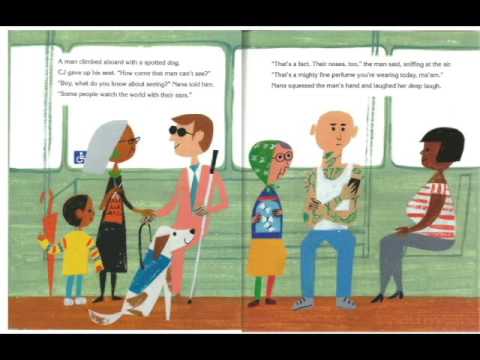
I think this book could definitely be used to support students’ critical literacy. It is a slow burn of a book, meaning that little by little it is giving the reader small moments to consider until the end when it all comes together in one culminating moment. I think the message in this book is of utmost importance in today’s world where most people have their heads buried in phones and kids are too busy playing video games to pay attention to what’s happening around them. How come we gotta wait for the bus in all this wet? Trees get thirsty, too. Nana, how come we don’t got a car? Boy, what do we need a car for? (de la Peña, 2015). For every question that CJ comes up with, Nana has a response question with a more positive spin on it. She challenges not only CJ, but also the reader to notice the small things that surround us on a daily basis. This book lends itself nicely to exploring different perspectives, specifically that of CJ and that of his grandmother. The fact that they are experiencing the same things, but feeling them in very different ways is central to this book and one that would support critical literacy in students.
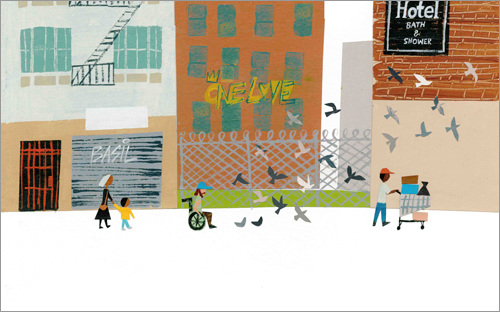
This book also connects to social justice. It lightly touches upon the differences between wealth and social status. CJ’s friend has a car, while he does not. The area that the soup kitchen is located in is covered in graffiti and is dirty highlighting the difference between neighborhoods. Both of these things could open up the conversation for students to discuss and evaluate in their own communities. It is a powerful message for both adults and students to challenge their thinking on privilege and poverty.
 Good Books
Hi Emily,
You make some very good observations about “Where the Mountain Meets the Moon,” such as prompting the readers to examine what they value and also consider the point of view or perspective of other characters (such as the parents during the time Minli is gone). I agree with you that the book would also make an excellent supplemental or introductory text in a study of contemporary Asia. I really appreciate your comment, Emily, about the controversial topic of “If I were your Girl” and that as professional educators, it is our role to help students consider and examine multiple perspectives. As stated before, it is always important to consider the context, audience, intention and purpose when selected a title to share with students. Imagine being a transgendered student who has not gone public sitting in your classroom. This is in part, how this book was selected for 5795. And, yes, the book would support a rich application of critical literacy – there are so many questions and perspectives to be considered. I agree with you that “Market Street” lends itself well to an application of critical literacy. In fact, CJ actually starts the reader on posing questions, ultimately prompting the reader to consider, what is important in life? And, the contradicting views held by CJ and his grandmother maximize these questions. Sherry Taylor
LikeLike