“Most people seem to be interested in turning their dreams into reality. Then there are those who turn reality into dreams. I belong to the latter group.”-Allen Say
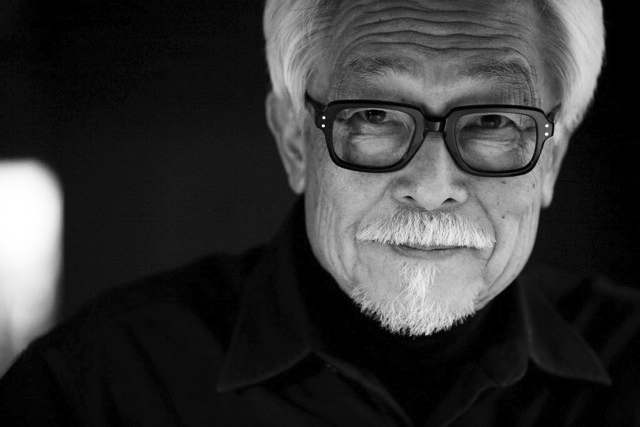
Allen Say was born in Yokohama, Japan in 1937 and had to overcome many adversities throughout his childhood. After his parents divorced, Allen moved in with his grandmother. However, the relationship was not the best and he soon moved out and lived on his own. When Allen was sixteen, he moved to California with his father and experienced post World War 2 racism. His career originally started in photography, but then spread into illustrations after the directors he worked with encouraged him to do so. In 1972, he published his first book, Dr. Smith’s Safari. In 1988, he quit photography and dedicated his time solely to writing and illustrating books.
Grandfather’s Journey, written and illustrated by Allen Say, was published in 1993 and received the Caldecott medal. The book tells the story of Say’s grandfather who traveled from Japan to America. He becomes enamored with the New World, but soon realizes that he is homesick for Japan, so makes the trip back. The message simple, in being that, “The moment I am in one country, I am homesick for the other.” I would say that this book is a non-fiction picture book.
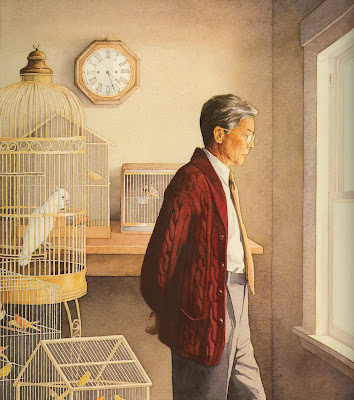
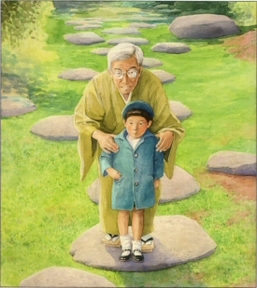
The text in Grandfather’s Journey is simple, yet heartfelt. Strategically located on the bottom of each page, the reader’s attention is therefore drawn to the illustrations. Say uses every color available from blues to greens to pinks, but they are muted, giving off the feeling that you are looking through the photo album of a distant relative. The intentional use of color has an effect on the mood of each page. He uses dark grays and blacks, as well as sharp lines, on the page describing the factories and buildings of the big cities. Then on another page, he uses vibrant greens and whites to showcase the young couple falling in love. The reader is an active participant in the story, feeling the feelings of the grandfather, and making a connection to his journey. For a younger reader, this may be harder to do. However, as an adult, and having grown up in Ohio, the message of being in love with more than one place, resonates with me.
Art is natural for creating the setting in an illustrated text (Tunnell et al, 2016, p. 38). Allen Say uses his pictures to accentuate the setting from Japan to California to the traveling in between. The reader is able to see the similarities between the two places, reaffirming the message of having connections to more than one place.
This book would be a strong anchor book for a personal narrative unit. I find that students struggle with showing the reader, rather than just telling them. This is a simple model text that students can use throughout each step. I also think it would be a good text to use when teaching about World War 2 and the Japanese internment. In Allen Say’s biography, he talks about the racism he experienced in California post WWII. While the book doesn’t necessarily talk about that, you could pair it with an author biography to blend the two topics. It also would fit nicely with a mini-lesson on perspective.
 Good Books