“I have never lost the child in me. My father would spin endless tales of his own to entertain our imaginations on summer nights lying on the flat roof of our house. I have never forgotten the images I saw in my mind.” – Ed Young
Seven Blind Mice is a children’s fictional picture book, written and illustrated by Ed Young. The book was published in 1992 and received the Caldecott medal. This book is about seven blind mice, who one day, are confronted with a strange Something by their pond. As each day passes, one of the mice explores the strange object to determine what it may be. On the seventh day, the last mouse goes over, and after exploring the whole thing, discovers that the object is in fact an elephant.
Ed Young was born in Tianjin, China, grew up in Shanghai and later moved to Hong Kong. As a young adult, he moved to the United States to pursue architecture, but instead followed his passion for art. He began his career in advertising, but soon moved into children’s books where he was able to express himself more freely. He has illustrated over eighty books, which includes seventeen that he wrote, and has won numerous awards for his work. He credits much of his work to the philosophy of Chinese painting, stating that, “A Chinese painting is often accompanied by words. They are complementary. There are things that words do that pictures never can, and likewise, there are images that words can never describe.”

Seven Blind Mice would be considered both a counting book and a concept book. While not as traditional as other counting books, it does present children with the opportunity to learn and interact with numbers one through seven, specifically with ordinal numbers. The book opens with, “One day seven blind mice were surprised to find a strange Something by their pond.” As each page builds on the previous one, Young uses ‘first’, ‘second’ and so on until the seventh mouse goes and is the ‘last’ to go. This is a simple and easy story for readers to follow along with as they see the sequence of events unfold, which is another concept that this book does a good job with. This story also incorporates primary colors by labeling each mouse with a specific color and referring to those colors throughout the story.
Lastly, the story ends with a “mouse moral” stating, “Knowing in part may make a fine tale, but wisdom comes from seeing the whole.” While I believe the message is important, I think it would be rather hard for a younger audience to comprehend. It also takes away from the imaginative nature of the mice as they try to navigate this strange Something.
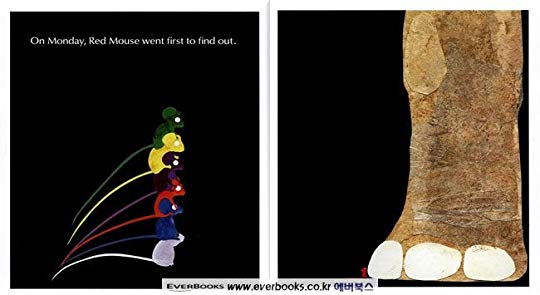
However, what makes this story interesting, is the pictures. I mean, Young won the Caldecott for them! The two main characteristics of the illustrations that I notice right away are color and texture. I’m left to wonder though, which came first? The words or the illustrations? Regardless, they complement each other nicely and allow the story to flow in a natural way. He does a wonderful job at setting the tone of the entire book by using a black background. In this way, he is able to accentuate the colors and texture that he uses, making them pop on the pages. The reader is able to focus on the images and really notice the colors and texture.
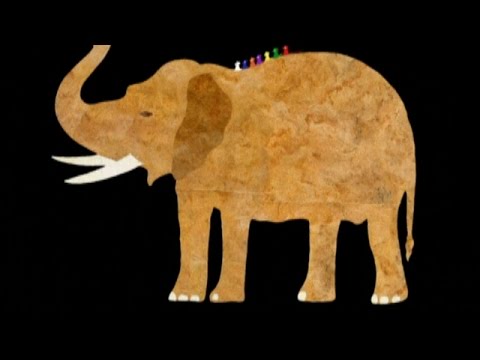
There is a mixture of what appears to be watercolors and paper collages. The paper collages are reserved for the elephant while the watercolors are used for the mice and for the items the mice think the Something is. I like the simplicity of Young’s illustrations, and feel that they are able to capture the attention of the reader without overwhelming them.
 Good Books
Your thinking about the “mouse moral” is really interesting and a different take than mine, but I really appreciate it. I think what I love about this story and that moral is that it can be used in different ways based upon your students’ ages. For younger students, maybe you do skip that page so it doesn’t confuse them or take away from their imaginative interpretation. For older students though, this moral should be shared and discussed as it is powerful. His dedication on the final page is also of interest as he shares an appreciation for wisdom “in those trying years.” That could also be a discussion point for older students who could connect his dedication to his “mouse moral” in interesting ways.
I also loved your reflection on the actual medium of the drawings. I like how it absolutely could be a mixture of materials, that makes it more layered and interesting to look at.
Thank you for your insight and reflection, it was great to read after writing my own!
Always learning,
Penny
LikeLiked by 1 person
Thank you for your comments Penny! I love the versatility of children’s books and your suggestions in using this book with older students is spot on.
LikeLike